


Reading Your Furniture’s Cleaning Code Before You Clean Upholstery Fabric
Upholstery fabric can look sturdy and still react badly to the wrong cleaner. A guide from Virginia Cooperative Extension, How To Care For Upholstered Furniture, warns that on some fabrics, water-based or solvent cleaners can cause shrinking, fading, or pile distortion. So before you think about how to clean upholstery fabric, find out what your fabric can handle. That information is in the cleaning code.
Where to find the cleaning code
Most upholstered pieces carry a care label with a letter code. Look under the seat cushions, on the underside of the frame, and in any paperwork that came with the furniture. The code may be a single letter or a combination.
If there’s no label and no paperwork, treat the piece with the most caution: vacuum it, and don’t apply water or any cleaning product until you know more about the fabric.
What W, S, W/S and X mean
Virginia Cooperative Extension describes the codes this way:
- W: Spot clean with a water-based foam, such as a mild detergent or a non-solvent upholstery shampoo. Pretest first. For overall soiling, use a professional.
- S: Spot clean with a mild water-free solvent or dry-cleaning product, in a well-ventilated room. Professional cleaning is recommended.
- W/S (also written S-W): Either a mild solvent or a water-based foam may be used, with the same precautions. For overall soiling, use a professional.
- X: Vacuum or brush lightly only. Water-based or solvent cleaners may cause shrinking, fading, or pile distortion.
Notice that the codes describe spot cleaning. None of them suggests soaking a whole cushion or washing the fabric at home.
Routine care that keeps fabric looking its best
Most of what keeps furniture upholstery looking its very best happens between spills. The same extension guide recommends:
- vacuuming weekly with an upholstery attachment;
- fluffing and reversing loose cushions regularly;
- keeping furniture out of direct sunlight;
- leaving zippered cushion covers on rather than removing them to wash;
- treating spills promptly.
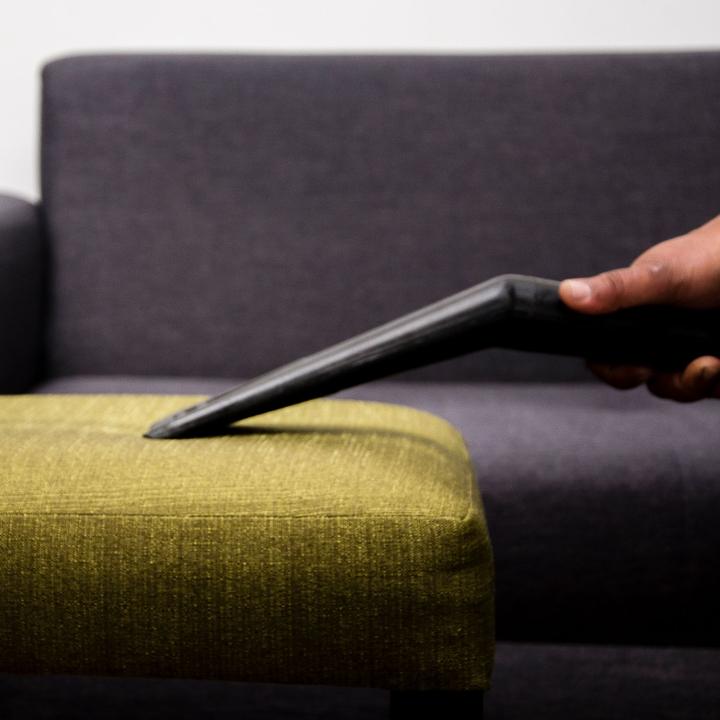
Regular vacuuming matters even on X-coded fabrics, since it’s the one cleaning step every code allows.
Test on a hidden spot first
Pretesting is part of every code that allows a cleaning product. Pick an area no one sees: the back of a skirt, the underside of a cushion, or fabric inside the frame near a seam. Apply a small amount of the product the code allows, blot with a clean white cloth, and let the spot dry completely.
Then look closely. If color has come off onto the cloth, if a ring has formed, or if the fabric feels stiff or looks fuzzy, don’t use that product on the visible areas.
Spot cleaning a fresh spill
Start the same way regardless of code: blot up as much liquid as you can with a clean white cloth, pressing rather than rubbing.
After that, the code decides. On W or W/S fabric, use a small amount of water-based foam and blot; the goal is to dampen the spot, not soak the cushion. On S fabric, use a water-free solvent product sparingly and keep the room ventilated. On X fabric, stop after blotting and, once the spot is dry, vacuum or brush it lightly.
For specific spills, UGA Extension’s stain guides include instructions for upholstered furniture that take the fiber type into account.
When professional cleaning makes more sense
The codes themselves point to the limits of home care. Virginia Cooperative Extension recommends professional cleaning for overall soiling on W and W/S fabrics, recommends it for S fabrics in general, and limits X fabrics to vacuuming and light brushing at home.
A few other signs suggest it’s time to stop: a home attempt that left water rings or uneven color, an older or delicate fabric, or a piece with no label at all. In those cases, furniture upholstery fabric cleaning by a professional is safer than another round of trial and error.